Speech - A Reliable Biomarker for the Brain
Updated: Apr 12
Analyzing speech patterns is similar to taking a blood sample in that they both provide medically-reliable, actionable insights. A person's cholesterol, sodium, iron, and glucose levels are all highly informative pieces of information extracted from a blood panel. Likewise, a person's intelligence, mental health, personality profile, and even honesty can be extracted from their speech patterns. The purpose of this paper is to provide evidence and support for this assertion focused on three mental health related examples. If one can buy into the idea of speech as a reliable indicator for what's going on in a person's brain, the applications to investing become obvious. How valuable would it be to understand a CEO or CFO's mental blueprint and the implications for how they are likely to run their business? Using linguistic AI tools, Qualex Investment Management harnesses these types of insights in our investment and portfolio construction process.

Example 1: Absolutist Mindset
Absolutist thinking occurs when someone has difficulty seeing nuance. It's a black-and-white thought pattern found in many cognitive disorders such as depression, suicidal ideation, and bi-polar disease. Words and phrases such as "all", "nothing", "always" or "never" are considered absolute words because they are extreme and unqualifying in their characterization. As most people understand, or at least upon further contemplation, it is very rare for something to "always" or "never" be a certain way.
The appeal, however, of absolutist thinking is that it simplifies reality into binary views and decisions. It's less work for the brain, and more comfortable in general, to think this way then to have to grapple with, sort through, and process the complexities of most real situations. For those struggling with depression or similar mental health issues, absolutist thinking can be a coping mechanism for a brain already stressed and overloaded. For this reason, psychologists and computational linguists have used usage levels of absolute words as a diagnostic marker.
For example, researchers analyzed absolute word usage in various mental health forums (1). They found that usage increased with the severity of mental health struggles. Depression and anxiety forums showed nearly 1.5x the rate of absolute word usage compared with control forums, while forums focused on suicidal ideation were 1.8x higher.

This, and other similar studies, provide support for using linguistic tools to better understand what is going on in a person's brain and aid in diagnosing mental health issues. With advances in machine learning, some researchers have developed models reaching 80%+ accuracy in distinguishing individuals with depression from control groups (2).
Example 2: Cohesion & ADHD
Attention-deficit/ hyperactivity disorder (ADHD) is a common condition that impacts millions of children and adults. It is characterized, among other things, as a difficulty maintaining attention and/ or a state of being easily distracted and overstimulated. Researchers have been able to use natural language processing techniques to measure the cohesiveness of story telling in adolescent children, aiding in early diagnosis (3). It makes sense that a person who struggles with attention and distractibility would recount a memory in a more unstructured way, seemingly bouncing around from topic to topic. This can be measured and impacts the cohesion score in the chart below.
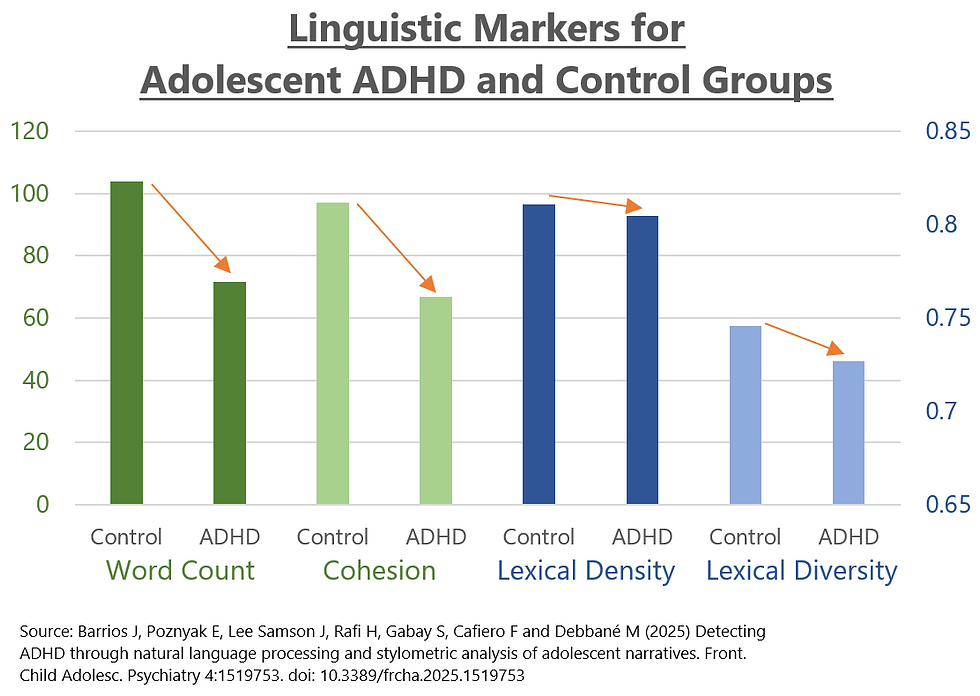
This provides, yet another, example in which a neurological structure can be detected simply by analyzing speech patterns. If this is possible in the medical arena, image what can be detected when analyzing the speech of management teams of publicly traded stocks.
Example 3: Lie Detection
Lastly, an example from the honesty and lie detection space. A pioneer in the computational linguistics industry, JW Pennebaker, published a study nearly two decades ago on the linguistic patterns of liars (4). His findings have since been reconfirmed numerous times. In particular, distancing language is a hallmark of liars as they subconsciously try to create mental space between themselves and their lie. This manifests itself in lower usage of first person pronouns (I, me, my, mine). It's as if the liar doesn't want to take full ownership of what they are communicating.

Pennebaker and his colleagues created a prediction model using the top 5 most predictive linguistic markers. The model was able to predict 68% of lies correctly while the human judges were only able to detect 30%. While the human judges in this study were particularly bad, most of the time humans are barely above a flip of the coin in detecting lies making a 68% success rate impressive.

Conclusion
The purpose of this paper was to establish scientific backing for Qualex Investment Management's foundational thesis that reliable and actionable insights can be derived from the way a person speaks. The examples cited here are only three of hundreds, if not thousands, of similar studies and findings from the field of computational linguistics. The applications to investment management are numerous. An investment process informed by unbiased assessments of a CEO's intelligence, honesty, sentiment, business strategy, and management philosophy has the potential for differentiated returns. Using linguistic AI tools, Qualex Investment Management harnesses these types of insights in our investment and portfolio construction process.
References:
1) Al-Mosaiwi, M., & Johnstone, T. (2018). In an absolute state: Elevated use of absolutist words is a marker specific to anxiety, depression, and suicidal ideation. Clinical Psychological Science, 6(4), 529–542.
2)) Fisher, H., Jaffe, N.M., Pidvirny, K. et al. Language-based detection of depression with machine learning: systematic review and meta-analysis. npj Digit. Med. 9, 273 (2026). https://doi.org/10.1038/s41746-026-02448-1
3) Barrios J, Poznyak E, Lee Samson J, Rafi H, Gabay S, Cafiero F and Debbané M (2025) Detecting ADHD through natural language processing and stylometric analysis of adolescent narratives. Front. Child Adolesc. Psychiatry 4:1519753. doi: 10.3389/frcha.2025.1519753
4) Newman ML, Pennebaker JW, Berry DS, Richards JM. Lying words: predicting deception from linguistic styles. Pers Soc Psychol Bull. 2003 May;29(5):665-75. doi: 10.1177/0146167203029005010. PMID: 15272998.
Disclosure:
Qualex Investment Management, LLC (the “General Partner”) offers interests in private limited partnership Qualex Fund LP (the “Fund”) pursuant to Rule 506(c) of Regulation D under the Securities Act of 1933. The offering is exempt from registration with the U.S. Securities and Exchange Commission and is available only to investors who are verified as accredited investors under applicable securities laws and who meet suitability criteria outlined in the most recent Confidential Private Placement Memorandum. This post is for informational purposes only and does not constitute an offer to sell or a solicitation of an offer to buy any securities or interests in the Fund. Any descriptions of strategies, performance, or terms are preliminary, subject to change, and should not be relied upon for investment decisions. Any offering of interest in the Fund will be made solely pursuant to the Fund’s confidential offering documents, including its Confidential Private Placement Memorandum, limited partnership agreement, and subscription materials, which contain important information regarding the investment objectives, risks, fees, and expenses of the Fund. Nothing on this site constitutes investment, financial, legal, or tax advice or a recommendation. Prospective investors must consult their own legal, tax, and financial advisors. Investing in private investment funds involves substantial risks, including the possible loss of principal. Past performance is not indicative of future results. No regulatory authority has approved this information. Offers and sales will be made only in jurisdictions where permitted by law.



Comments