Applying Natural Language Processing to Equity Investing
Updated: Apr 9
As explored in prior insights, there is substantial scientific support for using natural language processing to extract meaningful signals about a person’s intelligence, personality, and behavioral tendencies. Applying these findings to equity markets, however, requires a nuanced understanding of CEO speech patterns, public company communication norms, and industry context. This paper provides a high-level overview of a few customizations required to effectively implement NLP in equity investing.

Example 1: Linguistic Markers Fall on a Spectrum
If only it were as simple as taking the findings from cognitive research in other domains and applying them directly to the equity markets. While insights from decades of computational linguistics research are inspirational and directionally helpful, the stock market requires a customized approach. One reason for this is the fact that many linguistic markers reside on a spectrum. For example, higher usage of personal pronouns (I, me, my, mine) has been associated with positive traits such as ownership and accountability, but also with mental health issues such as depression and suicidal ideation. Lower levels of personal pronoun usage have been associated with objectivity and social status, but also with distancing language that could indicate deception or lying. What emerges is a framework that could look like the below.
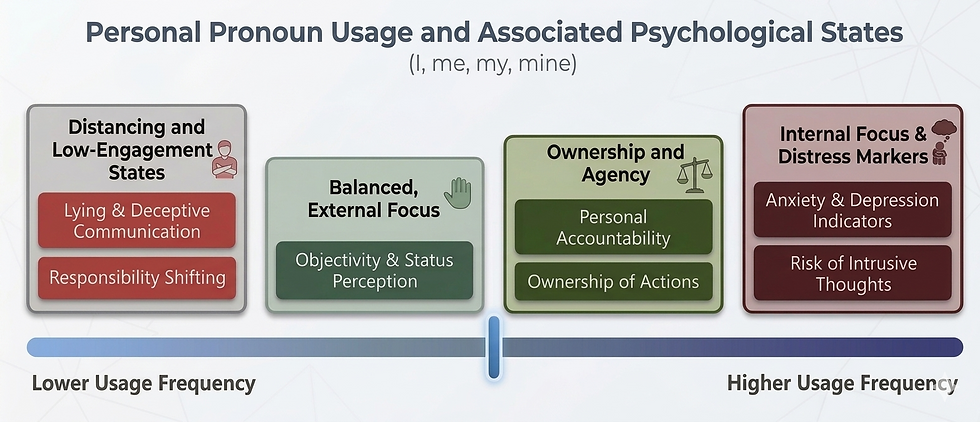
Personal pronoun usage of CEOs has predictive value in the stock market, but it needs to be optimized and combined with other complementary lexical metrics. For example, understanding the personal accountability level of a CEO is amplified by pairing personal pronoun usage with other language that also signals ownership and responsibility. Conversely, if the goal is to measure the objectivity of a CEO, modestly lower usage of personal pronouns combined with other lexical metrics would more accurately zero in on that factor. At the extremes, both high and low pronoun usage can become negative indicators, potentially reflecting emotional distress or deceptive intent. The Qualex research process strives to have a deep and differentiated understanding of stock market NLP applications.
Example 2: Intelligence and Complexity
The goal of intelligence ranking is not merely to identify CEOs who speak with the greatest complexity or largest vocabularies. In fact, computational linguists have found that too much complexity in speech can indicate efforts to obscure, cover up, or lie. Often, the most effective leaders are those who can distill complex ideas into clear, understandable, and actionable messages. As a fundamental equity analyst and portfolio manager, I observed this repeatedly. The best managers take complicated situations, identify elegant solutions, and mobilize large organizations around a clear vision.
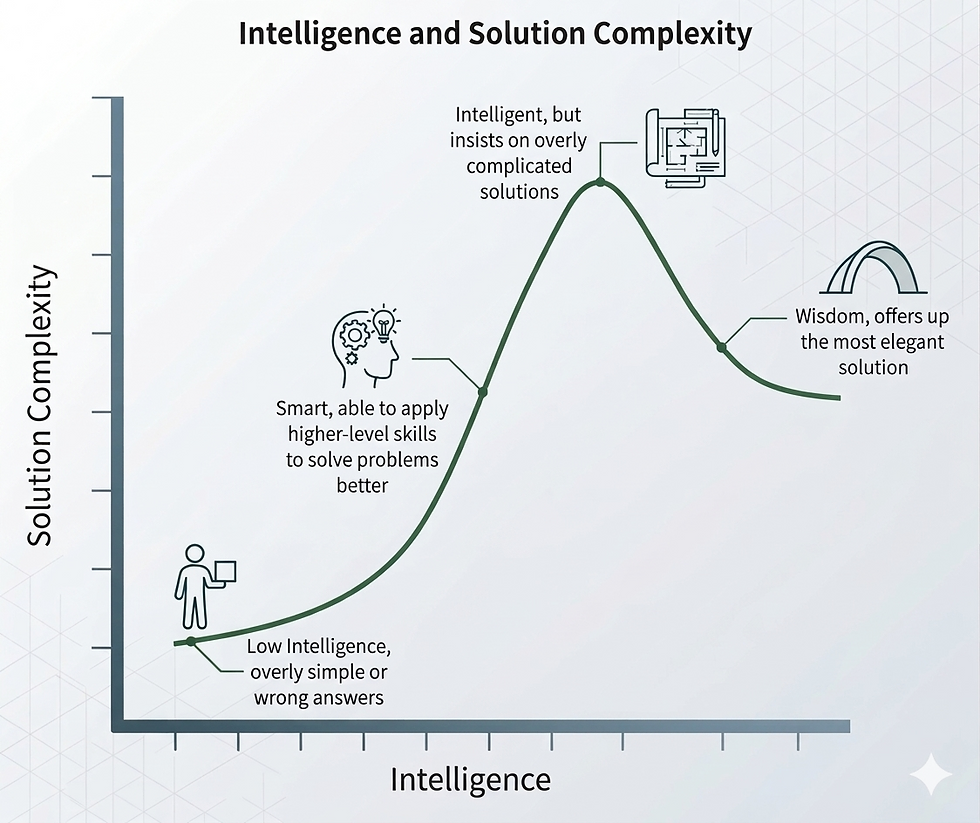
The following mental framework is instructive. If intelligence and solution complexity were plotted on a graph, it might look like the curve shown above. Early in one's development, individuals tend to propose overly simple or even wrong answers. It's not necessarily their fault, they either lack experience or education. As a one becomes smarter, they acquire more advanced skills that allow for better problem solving. At this stage, they rightly apply more involved solutions and find outcomes do improve. Some continue on, becoming even more intelligent and the positive reinforcement pattern experienced for years of applying more complicated solutions to get better results starts to break down. These types of people and managers are generally insufferable - peak confidence, peak complexity, confusingly low outcomes. It's possible to get stuck at this stage, relentlessly applying overly complex solutions to every business initiative.
A small group are able to push through into wisdom. The ability to offer up elegant solutions and ideas, balanced appropriately across complexity, simplicity, and ease of implementation. Not only does this type of mentality yield the strongest business results, it's an indication the CEO is competent in noise filtration and focused execution.
The Qualex intelligence ranking methodology seeks to optimize language patterns to find CEO's that fall into the wisdom intelligence bucket. These aren't necessarily those that speak with the most linguistic complexity or largest vocabularies, though they clearly have above average lexical structure, grammar, and word reservoirs. The wisdom CEOs are able to speak with efficiency and clarity. This is one of the most important customizations needed for the stock market relative to what's found in the computational linguistic research on intelligence.
Example 3: Industry Adaptation
Lasty, a quick note on industry adaption. Applying NLP to the equity markets requires some normalization between industries. Certain subject matters lend themselves to more sophisticated language. Take the same person and put them in charge of an industrial company one year and a biotechnology company the next. While many linguistic structures would remain intact and comparable, the subject matter would have some influence on certain markers. Understanding these nuances during portfolio construction is important.
Conclusion
The application of natural language processing to public equity markets can generate valuable, actionable investment insights, but nuances abound. Off-the-shelf solutions from other domains rarely translate reliably. Qualex Investment Management specializes in deep NLP research and rigorous backtesting of linguistic markers, delivering these insights through Qualex Fund LP, a long/short equity fund available to qualified investors and institutions.
Disclosure:
Qualex Investment Management, LLC (the “General Partner”) offers interests in private limited partnership Qualex Fund LP (the “Fund”) pursuant to Rule 506(c) of Regulation D under the Securities Act of 1933. The offering is exempt from registration with the U.S. Securities and Exchange Commission and is available only to investors who are verified as accredited investors under applicable securities laws and who meet suitability criteria outlined in the most recent Confidential Private Placement Memorandum. This post is for informational purposes only and does not constitute an offer to sell or a solicitation of an offer to buy any securities or interests in the Fund. Any descriptions of strategies, performance, or terms are preliminary, subject to change, and should not be relied upon for investment decisions. Any offering of interest in the Fund will be made solely pursuant to the Fund’s confidential offering documents, including its Confidential Private Placement Memorandum, limited partnership agreement, and subscription materials, which contain important information regarding the investment objectives, risks, fees, and expenses of the Fund. Nothing on this site constitutes investment, financial, legal, or tax advice or a recommendation. Prospective investors must consult their own legal, tax, and financial advisors. Investing in private investment funds involves substantial risks, including the possible loss of principal. Past performance is not indicative of future results. No regulatory authority has approved this information. Offers and sales will be made only in jurisdictions where permitted by law.



Comments